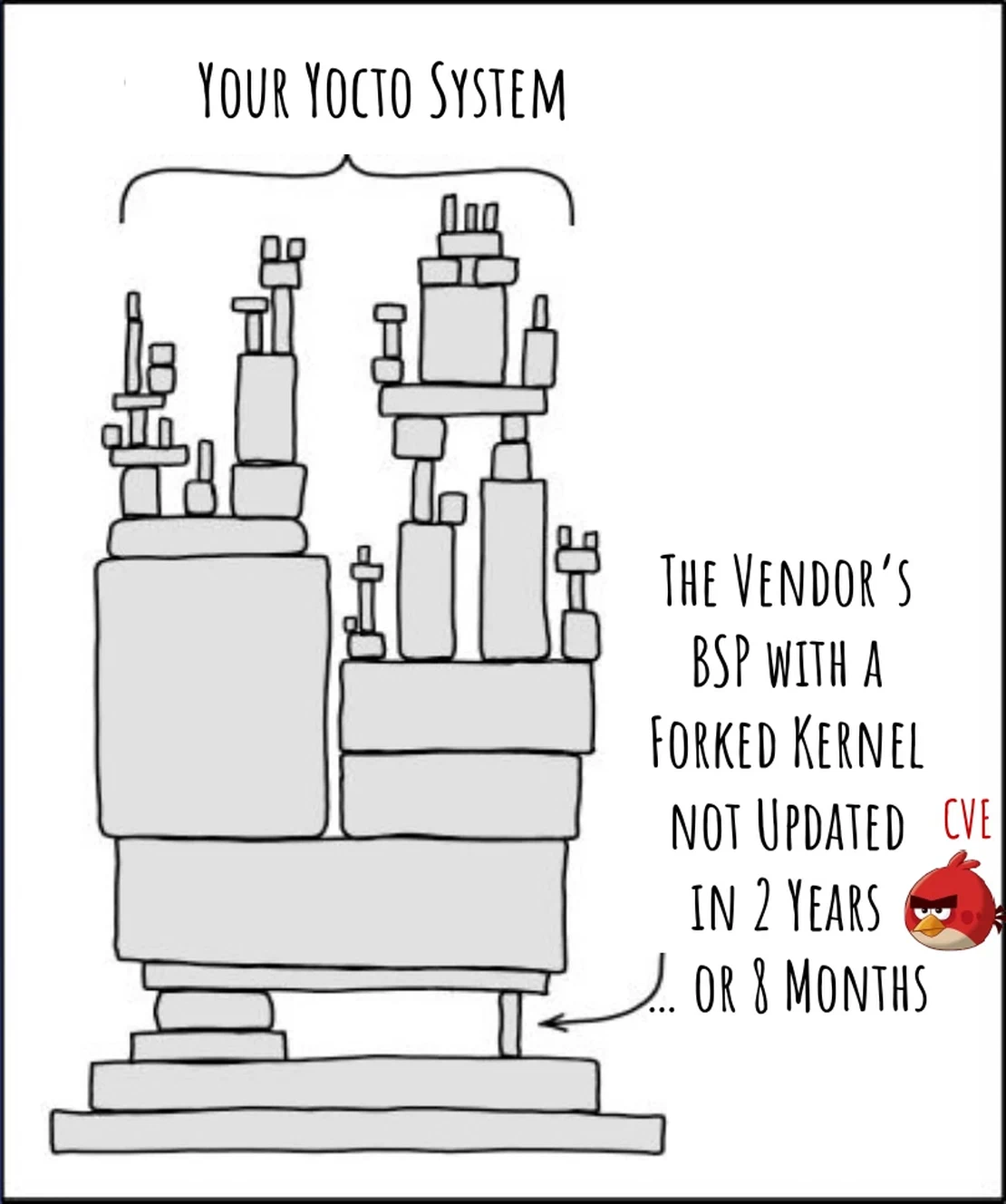
Your Vendor's BSP Is Probably Not Built For Product Longevity - Now What?
- Anna-Lena Marx
- Embedded , Conferences
- December 4, 2025
Vendor Board Support Packages (BSPs) are the standard for bringing new silicon to market, showcasing features, and promising an “easy” start. However, for those of us building products with long-term lifecycles, these BSPs often fail to meet quality requirements. They can be overly intrusive and typically don’t separate feature showcases from the well-maintained base needed for product development. This focus on rapid demonstration frequently results in BSPs which are difficult to maintain, lack transparency, and are built on non-LTS Yocto and kernel versions, making them unsuitable for products expected to last 5, 10, or even 20 years.
This talk will take a critical look at the state of vendor BSPs from an integrator’s perspective. We will explore the common pitfalls: opaque custom tooling, automatic inclusion of demo software, reliance on unmaintained kernel forks, and the widespread avoidance of Yocto LTS releases. We’ll discuss the differing perspectives of vendors and product developers, examine both good and bad real-world examples, and make the case for why writing your own sleek BSP layer is an absolutely valid strategy. Writing your own board descriptions and leveraging the stability of mainline Yocto and Linux kernels is not as daunting as it seems and can be the key to building truly sustainable and maintainable products.
Presented at
- Yocto Project Summit 2025.12, online
Related Posts
Building Trust - Use Cases and Implementation of TPM 2.0 in Embedded Linux Systems
- Anna-Lena Marx
- May 16, 2025
- Embedded , Conferences
Artwork by: Sparkelle (Yan) — Licensed under Creative Commons BY-SA 4.0
As embedded systems become increasingly interconnected, the demand for robust platform security and integrity has surged. Trusted Platform Modules (TPM), currently in version 2.0, are becoming increasingly beneficial for enhancing security in embedded systems. TPMs provide hardware-backed mechanisms for critical functions such as random number generation, cryptographic key generation, key binding and data sealing.
This presentation will explore the capabilities of TPM 2.0, focusing on several practical use cases, including:
Read Post
Patching Unpatchable Files
- Anna-Lena Marx
- December 5, 2024
- Embedded , Conferences
In the Yocto world, the .bbappend file is a well-known and documented mechanism for altering recipe files, and an essential part of daily operations. While not common, there are instances where it becomes necessary to modify other file types, such as .inc or .bbclass, which do not offer an equivalent append mechanism. This session will summarize various strategies for effectively handling these file types when patching cannot be avoided.
In my recent presentation at the Yocto Developer Day in Vienna, I mentioned using the KAS patch mechanism for minor modifications to files like .inc or .bbclass, where the Yocto internal overwriting mechanism via .bbappend files does not apply. Initially intended as a helpful side note on how I navigated a few unique situations, this part quickly escalated into the most discussed segment of the talk. Half of the attendees I spoke with found it valuable, while the other half expressed strong objections.
Read Post
Advanced System Profiling, Tracing and Trace Analysis with Perfetto in Android and Yocto
- Anna-Lena Marx
- October 8, 2024
- Embedded , Conferences
Together with my colleague Stefan Lengfeld.
Tracing is a capable mechanism for deep system analysis and profiling with a minimal overhead. By recording defined system events, in Linux but also Android, tracing can be used to analyze concurrency or latency issues, for example. Android’s systrace tool made it easy to analyze and correlate traces and events due to a graphical UI, in order to help developers identify performance bottlenecks. The successor to this advanced and convenient tool is called Perfetto. It’s available for pure Linux too, and part of Yocto (meta-oe) since Langdale now. In the talk, we’ll have a look into
Read Post