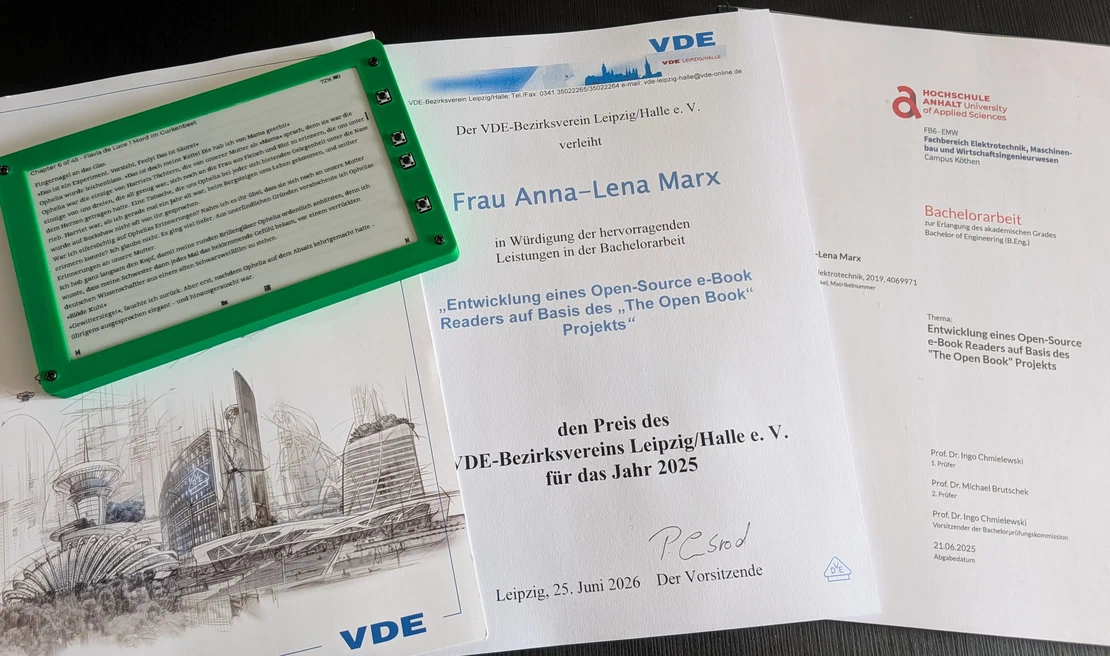
'VDE Best Thesis Award' for ZEReader Thesis
- Anna-Lena Marx
- ZEReader , Electronics
- July 30, 2026
Almost exactly one year after submitting my bachelor’s thesis in electrical engineering – which resulted in the ZEReader Project – I had the chance to meet one of my supervisors again and showcase how much the project has evolved since its initial version.
In mid-June, I received an email that my thesis would be awarded the ‘VDE Award’ for outstanding theses of the regional VDE association Leipzig/Halle, which my university belongs to. It was not completely unexpected, as my supervisors had told me after the final thesis defense that they would nominate my work. Still, living in Karlsruhe meant that attending a Thursday award ceremony in Leipzig on such short notice was quite a logistical challenge.
Together with my partner and even my parents, I was able to attend the event at the Elektrotechnische Sammlung Markkleeberg, present my thesis alongside the latest updates, and let people try it out for themselves. Beyond the honor of receiving the award, it was great to see my supervisor again and discuss which of the ideas from a year ago had become reality. Maybe I will also manage to finish writing the blog post about the second revision eventually.
The Elektrotechnische Sammlung (electrical engineering collection) itself is also worth a visit and probably rather unknown outside, and even within, Leipzig. Located in the rooms of an old transmission station, it features various exhibits from the history of electrical engineering collected by the VDE Leipzig/Halle. The volunteers in charge eagerly showed us around. And my father finally got to see a live mercury-arc valve in action, instead of just a video I took during my studies.
If you’re ever in Leipzig, check if the Elektrotechnische Sammlung is open to the public and pay it a visit!
Related Posts

International Women's Day - Why I wear Yocto Shirts on the Embedded World Exhibition
- Anna-Lena Marx
- March 8, 2024
- Personal , Embedded
Today, on the occasion of International Women’s Day, I’d like to give you an insight on working in Embedded as a woman: Why I’m searching for my best Yocto shirt and the nerdiest hoodie when I’m visiting the Embedded World exhibition.
Let’s go back some years to one of my first Embedded World visits. I was still a student doing my master’s degree in Embedded Systems. EW traditionally invites embedded students from all over Germany and adjacent countries on the third day, the student’s day. Together with some of my fellow students, I joined the trip and was looking forward to seeing new trends, talking to people, but also getting an idea where to apply for a job after finishing. At the exhibition, I started exploring together with some peers. Of course, all male. When going through the exhibition and talking to the people at the booths, I quickly recognized a pattern. The staff talked rather to the boys than to me. Mostly not quite obvious and probably not even on purpose. I think it’s about internalized stereotypes. They probably do not think that much about it, but obviously I was not a technically competent conversational partner to them at first sight, even if I asked the questions. I was an addition, an accompanying person from university or marketing. Mostly it was rather subtle, and I did not recognize it that much as the problem it was in the actual moment. But at some point we reached the Intel booth. I asked a question on something I was really curious about, and the male staff member started explaining to me and the accompanying students. During his talk, he started turning more to the boys until he showed me his back. I got a bit angry and told him directly that I would really like to hear the answer to the question I asked. Ok, bad, but human. So why am I telling this, and why do I mention Intel? Because I believe particularly such large companies should sensitize their employees working on a booth.
Read Post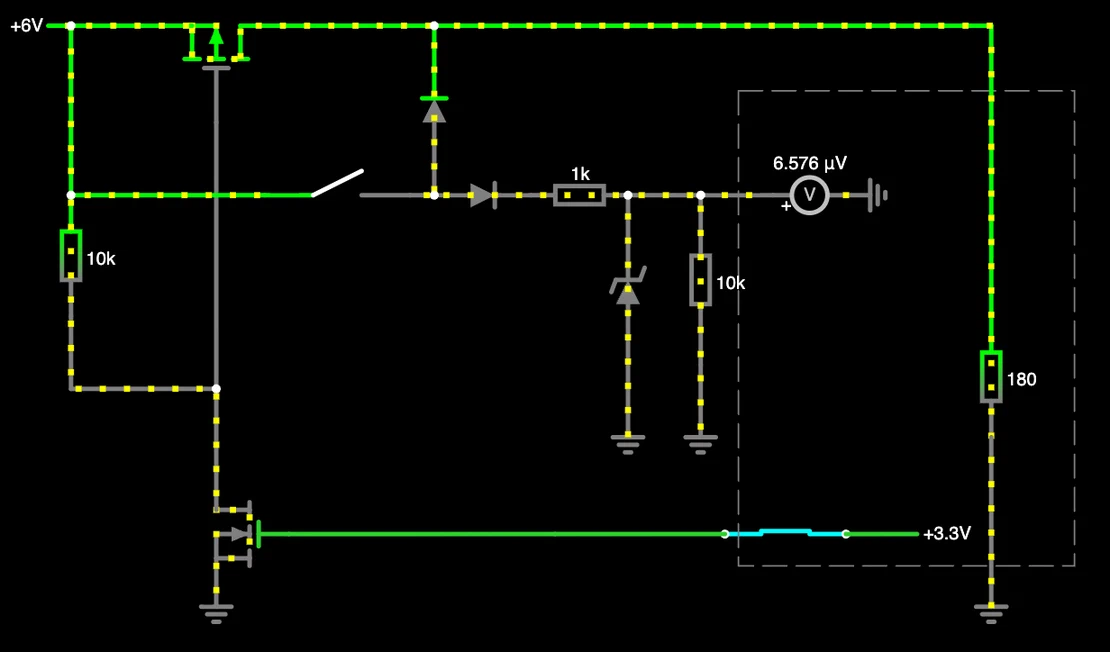
A Gentle Power Off for ZEReader: Replacing the Hard Switch with a Latching Power Circuit
- Anna-Lena Marx
- November 16, 2025
- Zereader , Electronics , Embedded
With the second revision, the way ZEReader is turned on and off got a massive redesign.
The hard on/off switch in the first revision was dead simple and worked great—with one big flaw from a user’s perspective. You could not recognize if the reader was on or off on the first sight. The old switch just closed or opened the loop with the power supply, and due to the E-Paper display just holding the state, you had no chance to tell.
Besides, there was no possibility at all to implement some kind of graceful shutdown mechanism, which would allow me to save all important state information and show a clear device off indicator.
This situation was totally fine for the very first prototype, but it started to get annoying very soon. A new approach was needed!
Yocto on the Edge - Unusual challenges when building not so embedded systems
- Anna-Lena Marx
- October 8, 2024
- Embedded , Conferences
Building embedded systems with Yocto on ARM platforms is a common practice, but when the products move further to the edge and become less “embedded,” new challenges arise. In this session, we will explore the requirements and challenges faced when developing Yocto-based systems for edge computing based on Intel.
We will dive into topics such as provisioning x86-based platforms, securely managing Linux user logins on a read-only root file system with enforced password changes, and implementing A/B updates together with secure boot. Real-world project requirements will be used as a guide to discuss practical solutions and best practices for addressing these challenges.
Read Post